Introduction to Ramana Maharshi & Who Am I?
Who am I? by Ramana Maharshi (Book Summary + Infographic)
Who is Ramana Maharshi?
- Ramana Maharshi was an Indian sage and jivanmukta (liberated being). He was born named Venkataraman Iyer, but he is most commonly known by the name Bhagavan Sri Ramana Maharshi.(1)
- At the age of 16, he had a “death-experience” where he became aware of a “current” or “force” (avesam) which he recognised as his true “I” or “self”, and which he later identified with “the personal God, or Iswara, that is, Shiva.(1)
- Six weeks later he journeyed to the holy mountain Arunachala where he took on the role of a sannyasin (though not formally initiated), and remained for the rest of his life.(1)
About Who Am I? (Nan Yar?): Introduction by T.M.P. Mahadevan
- “Who am I? is the title given to a set of questions and answers bearing on Self-enquiry.”
- “The questions were put to Bhagavan Sri Ramana Maharshi by Sri M. Sivaprakasam Pillai, about the year 1902…This record was first published by Sri Pillai in 1923 (in the original Tamil), along with a couple of poems composed by himself relating how Bhagavan’s grace operated in his case by dispelling his doubts and by saving him from a crisis in life.”
- “Along with Vicharasangraham (Self-Enquiry), Nan Yar (Who am I?) constitutes the first set of instructions in the Master’s own words. These two are the only prose pieces among Bhagavan’s works. They clearly set forth the central teaching that the direct path to liberation is Self-enquiry.”
- “The mind consists of thoughts. The ‘I’-thought is the first to arise in the mind. When the enquiry ‘Who am I?’ is persistently pursued, all other thoughts get destroyed, and finally the ‘I’-thought itself vanishes leaving the supreme non-dual Self alone. The false identification of the Self with the phenomena of non-self such as the body and mind, thus ends, and there is illumination, sakshatkara.”
The Ultimate Question: Who am I? The Teachings of Bhagavan Sri Ramana Maharshi (Book Summary)
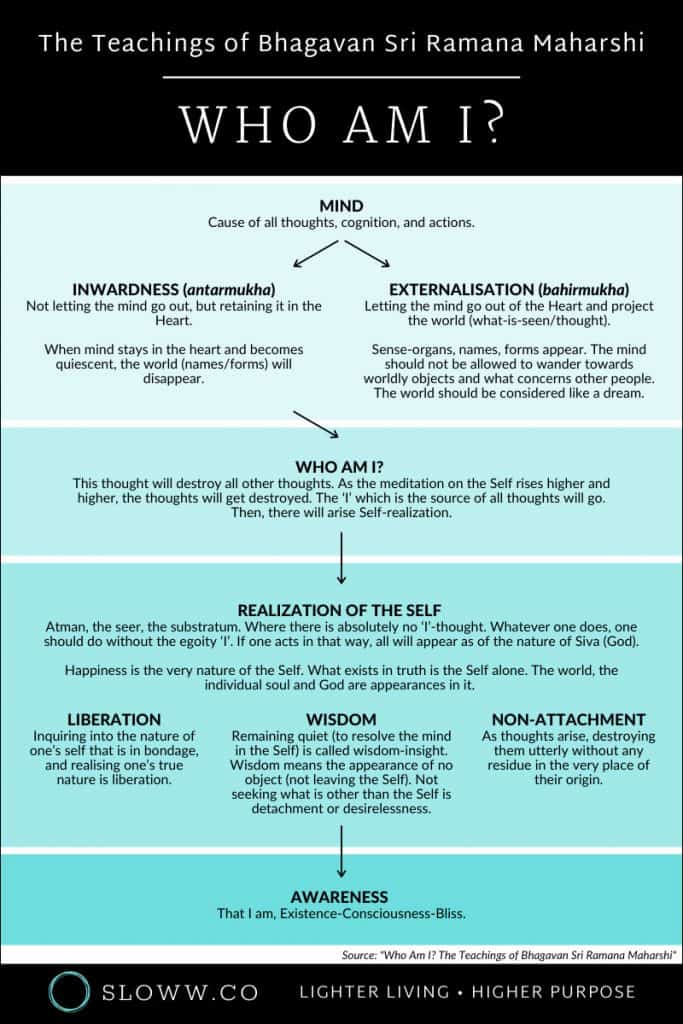
In an attempt to better absorb and digest Ramana Maharshi’s teachings, I created this visual summary for myself which may be helpful for you as well:
1. On the World
“The world should be considered like a dream.”
- “Waking is long and dream short; other than this there is no difference. Just as waking happenings seem real while awake, so do those in a dream while dreaming. In dream the mind takes on another body. In both waking and dream states thoughts, names and forms occur simultaneously.”
2. On Mind
“What is called ‘mind’ is a wondrous power residing in the Self. It causes all thoughts to arise. **Apart from thoughts, there is no such thing as mind.**Therefore, thought is the nature of mind. Apart from thoughts, there is no independent entity called the world.“